- English
- Español
- Português
- русский
- Français
- 日本語
- Deutsch
- tiếng Việt
- Italiano
- Nederlands
- ภาษาไทย
- Polski
- 한국어
- Svenska
- magyar
- Malay
- বাংলা ভাষার
- Dansk
- Suomi
- हिन्दी
- Pilipino
- Türkçe
- Gaeilge
- العربية
- Indonesia
- Norsk
- تمل
- český
- ελληνικά
- український
- Javanese
- فارسی
- தமிழ்
- తెలుగు
- नेपाली
- Burmese
- български
- ລາວ
- Latine
- Қазақша
- Euskal
- Azərbaycan
- Slovenský jazyk
- Македонски
- Lietuvos
- Eesti Keel
- Română
- Slovenski
- मराठी
- Srpski језик

Food Truck vs Food Trailer: Which Is Better for a Mobile Food Business?
Starting a mobile food business requires more than choosing a menu and finding a location. The type of mobile kitchen you choose can affect your equipment layout, operating space, transportation, service workflow, and future business expansion. For many entrepreneurs, the main decision comes down to a food truck vs food trailer.
Both options can provide a professional mobile kitchen for street food, catering, festivals, coffee, BBQ, pizza, fast food, and other food concepts. However, they are built around different operating models. A food truck integrates the kitchen and vehicle into one unit, while a food trailer separates the kitchen from the towing vehicle.
So which one is right for your mobile food business? The answer depends on how you plan to operate, how much kitchen space you need, how frequently you move, and what type of food you intend to serve.
What Is a Food Truck?
A food truck is a motorized vehicle that combines transportation and food preparation in one mobile unit. The cooking area, service counter, storage, water system, electrical system, and other equipment are installed directly inside the vehicle.
This integrated design makes food trucks suitable for businesses that need to move frequently between different locations. They can be used for street food, lunch services, festivals, corporate catering, private events, and other mobile food operations.
Depending on the concept, a food truck can be equipped with refrigerators, sinks, cooking equipment, ventilation systems, worktables, storage cabinets, and other commercial kitchen equipment. The internal layout can also be planned around a specific menu and service process.
What Is a Food Trailer?
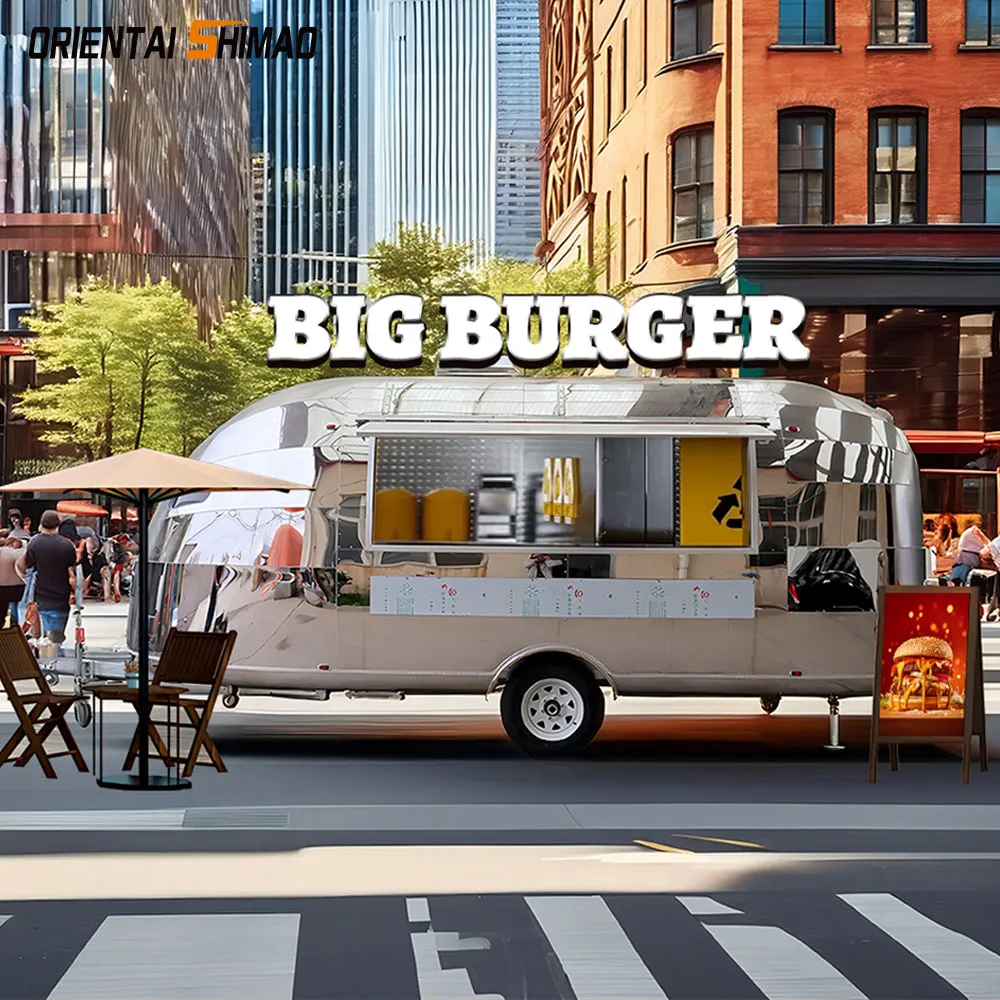
A food trailer is a mobile kitchen mounted on a towable chassis. Unlike a food truck, the trailer does not normally contain its own driving system, so it is moved by a separate vehicle.
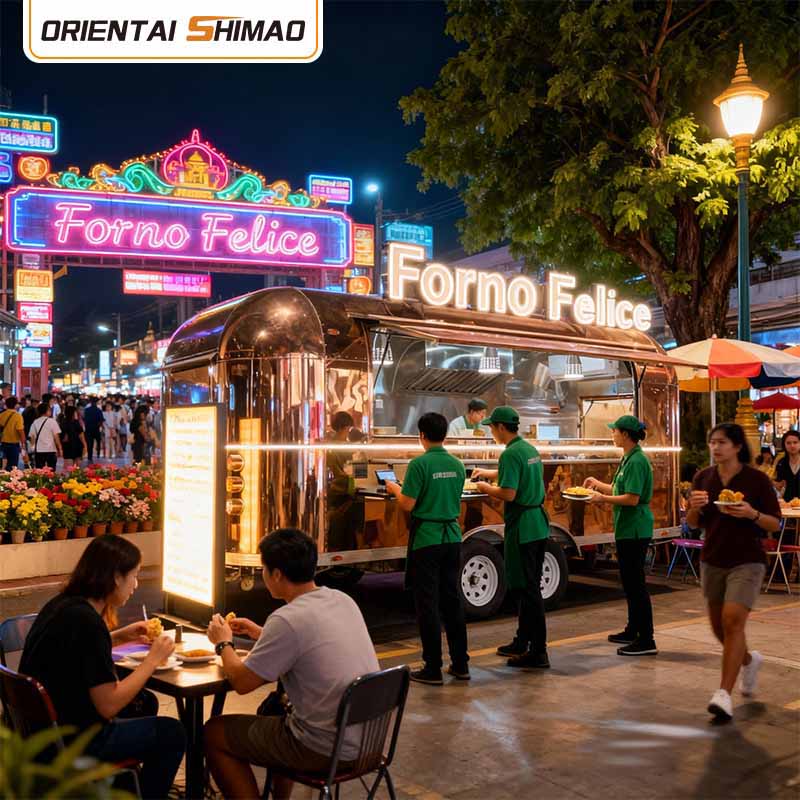
Food trailers are available in different sizes and configurations. They can be designed as concession trailers, catering trailers, Airstream-style trailers, square food trailers, or mobile kitchen trailers. Depending on the size and layout, a trailer can accommodate equipment for coffee, burgers, pizza, BBQ, fried food, desserts, beverages, and other menus.
A food trailer can also be customized according to the operator's requirements. For example, Oriental Shimao's mobile food trailer configurations can include 304 stainless steel workbenches, water systems, lighting, braking systems, refrigeration, sinks, range hoods, grills, fryers, and other equipment, depending on the intended application.
Food Truck vs Food Trailer: Key Differences
| Factor | Food Truck | Food Trailer |
|---|---|---|
| Transportation | Self-propelled vehicle | Requires a towing vehicle |
| Mobility | Convenient for frequent relocation | Better suited to planned locations and events |
| Kitchen space | Limited by the vehicle body | Can offer a larger working area depending on trailer size |
| Vehicle integration | Kitchen and vehicle are one unit | Kitchen and towing vehicle are separate |
| Layout flexibility | Depends on vehicle dimensions | Wide range of trailer sizes and layouts |
| Event operation | Can drive directly to the service location | Can remain at a selected location after setup |
| Expansion | Expansion may require another vehicle | Trailer can potentially be exchanged or upgraded separately |
Mobility: Which Option Is Easier to Move?
If your business model requires frequent movement throughout the day, a food truck can be more convenient. Since the kitchen and driving system are integrated, the operator can leave one location and travel directly to another without connecting or disconnecting a trailer.
A food trailer takes more preparation when changing locations because it needs a suitable towing vehicle. However, this does not necessarily make it less practical. For businesses that operate at festivals, markets, catering venues, private events, or semi-permanent locations, a trailer can remain in place for longer periods without requiring frequent relocation.
The better choice therefore depends on your operating schedule rather than mobility alone.
Kitchen Space and Workflow
Kitchen layout is one of the most important factors when choosing between a food truck and a food trailer.
A food truck needs to balance the driving area with the kitchen area. Every square meter must be planned carefully for cooking, preparation, storage, refrigeration, washing, staff movement, and customer service.
A food trailer can provide greater flexibility in how the interior is arranged because the trailer is dedicated to food service rather than also accommodating a driver's cabin and vehicle controls. Larger trailer models can provide additional room for equipment and staff, making them suitable for menus that require several preparation or cooking stations.
For example, a mobile catering trailer can be customized with equipment such as refrigerators, sinks, range hoods, gas grills, fryers, worktables, water heaters, and other appliances. The equipment configuration can be adjusted according to the menu and available interior space.
Which Is Better for Different Food Businesses?
Coffee Business
A coffee truck or compact coffee trailer can work well for businesses serving espresso, coffee, tea, cold drinks, and simple snacks. The key considerations are counter space, water supply, electrical capacity, refrigeration, storage, and the number of staff working inside.
Fast Food Business
Burgers, fried chicken, hot dogs, tacos, and similar concepts may require multiple cooking stations. A larger food trailer can provide additional space for cooking equipment, preparation areas, and storage.
Pizza Business
Pizza operations usually need dedicated oven space, preparation counters, refrigeration, ingredient storage, and service areas. The layout should allow staff to move efficiently between preparation, cooking, and serving.
BBQ and Outdoor Catering
BBQ and event catering businesses often benefit from a larger mobile kitchen because they may need grills, fryers, refrigerators, preparation tables, and additional storage. A catering trailer can be configured around these requirements and remain at the event location during service.
Small or Compact Food Concepts
If the menu is relatively simple and the business needs to operate in areas where space is limited, a smaller food truck or food cart may be sufficient. Oriental Shimao also offers food carts and compact mobile food solutions for concepts such as coffee, fast food, desserts, and street food.
Customization: Food Truck or Food Trailer?
Customization is important when the mobile kitchen needs to support a specific menu or brand concept. Both food trucks and food trailers can be customized, but the available space and chassis design influence the final configuration.
Common customization options include:
- Overall dimensions and exterior design
- Branding, logo, colors, and exterior graphics
- Service windows and counters
- 304 stainless steel worktables and cabinets
- Sinks and hot and cold water systems
- Refrigeration and freezer equipment
- Cooking equipment such as grills, fryers, ovens, and burners
- Ventilation and range hood systems
- Electrical and lighting systems
- Storage areas and specialized equipment
For businesses with a highly specific workflow, it is useful to provide the manufacturer with the menu, equipment list, number of operators, target serving volume, available parking or event space, and local requirements before finalizing the design.
Food Truck or Food Trailer: What Should You Consider Before Choosing?
Instead of comparing the two options only by purchase price, consider the complete operating model.
1. How Often Will You Move?
If you change locations several times a day, the integrated design of a food truck may simplify transportation. If you mainly travel to scheduled events and remain there for several hours or days, a trailer may be practical.
2. How Much Kitchen Space Do You Need?
Consider the number of cooking stations, appliances, preparation areas, storage requirements, and staff members. A complex menu generally requires more carefully planned kitchen space.
3. What Is Your Menu?
A coffee concept has very different equipment requirements from a BBQ, pizza, or fried-food business. Start with the menu and work backward to determine the equipment and layout.
4. What Is Your Towing Situation?
A food trailer requires a suitable towing vehicle and a driver who can handle the combined dimensions and weight. Before choosing a trailer, check the towing capacity and applicable local requirements.
5. Where Will You Operate?
Parking space, road access, event regulations, electrical availability, water and wastewater arrangements, and local food-service requirements can all affect the choice of mobile kitchen.
6. Do You Plan to Expand?
If you expect your business to expand into larger events or higher-volume catering, consider whether the initial layout can accommodate additional refrigeration, preparation space, storage, or cooking equipment.
How to Choose the Right Mobile Food Solution
There is no single configuration that works for every mobile food business. A practical approach is to define your operating requirements first and then choose the vehicle type.
- Define your menu: List every food and beverage item you plan to sell.
- List the equipment: Identify the cooking, refrigeration, preparation, washing, and storage equipment required.
- Estimate staffing: Determine how many people will work inside the mobile kitchen during peak service.
- Plan the workflow: Arrange preparation, cooking, storage, washing, and serving areas to reduce unnecessary movement.
- Check transportation requirements: Consider driving frequency for a food truck or towing requirements for a food trailer.
- Confirm local requirements: Check applicable vehicle, food-service, electrical, gas, sanitation, and registration requirements in your operating market.
- Choose the vehicle size: Select a truck or trailer that provides enough space without creating unnecessary operating costs.
Food Truck vs Food Trailer: Which One Should You Choose?
The choice between a food truck and a food trailer ultimately depends on the way you intend to operate your mobile food business.
A food truck may be suitable when frequent relocation, integrated transportation, and quick movement between locations are important. A food trailer may be suitable when you need a flexible mobile kitchen with more layout options and plan to operate at fixed locations, events, markets, or catering venues for longer periods.
For either option, the most important considerations are not simply the appearance of the vehicle. Kitchen workflow, equipment configuration, storage, utilities, transportation, local requirements, and future business needs should all be considered during the design stage.
Oriental Shimao manufactures food trucks, food trailers, food carts, and other mobile food solutions, with customized options for different business concepts. Its product range includes mobile food trailers, concession trailers, mobile kitchen trailers, food trucks, food carts, and application-specific solutions for coffee, fast food, pizza, desserts, and other catering businesses. The company also provides OEM/ODM customization for dimensions, layouts, exterior branding, and interior equipment.
Conclusion
Choosing between a food truck and a food trailer should start with your business model rather than the vehicle itself. Think about where you will operate, how often you will move, what you will serve, how many people will work inside, and what equipment your kitchen requires.
Once these requirements are clear, a manufacturer can help translate them into a suitable mobile kitchen layout. Whether you choose a food truck, food trailer, or another mobile food solution, a well-planned design can make daily operation more efficient and leave room for future customization.